
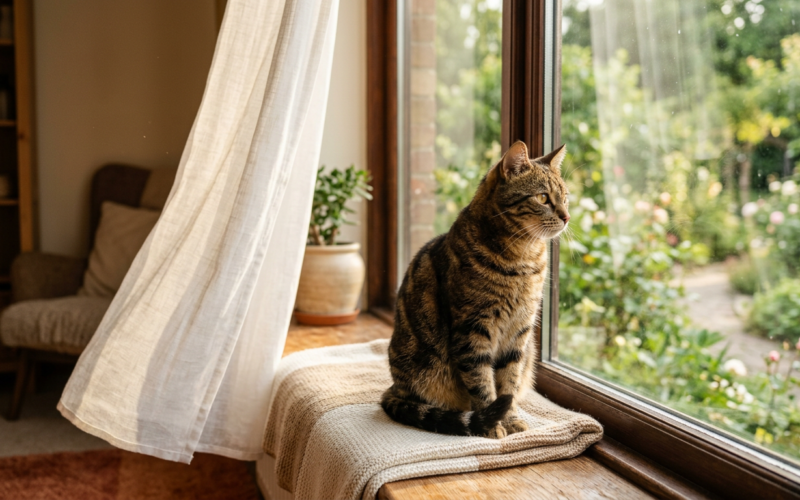
New research on cats making the move from outdoors to indoors landed this week with a finding that will surprise a lot of owners who have been putting it off. The transition went considerably better than people expected. Owners braced for weeks of yowling, door dashing and general feline protest, and mostly did not get it.
The strongest motivation for making the change was not wildlife or neighbors or convenience. It was safety, specifically traffic, attacks by other animals and disease. Which means most owners already know why they should do it and are stuck on whether they can.
What the Research Found
The core result is about the gap between anticipated difficulty and actual difficulty. Owners who moved cats indoors reported the adjustment being easier than they had feared, and cat safety dominated the list of reasons for making the change. That gap is the whole story. Fear of a miserable cat is the main thing keeping cats outdoors, and the fear appears to be larger than the reality for most animals.
Why Safety Is the Honest Argument
Outdoor life shortens feline lifespans in ways that are not subtle. Cars are the obvious hazard. Fights with other cats spread abscesses and viruses that are expensive to treat and sometimes untreatable. Parasites arrive constantly. Predators exist in more suburbs than people admit. Owners tend to accept these risks because the alternative feels cruel, which is a very human trade and worth examining rather than defending.
There is a second reason this research matters, and it has nothing to do with the cat. Free roaming cats are one of the more contested topics in conservation, and the argument usually gets conducted at maximum volume between people who love birds and people who love cats. What tends to get lost is that both camps want the same behavioral change, and the practical obstacle has never been ideology. It has been the belief that a cat used to going outside will be miserable forever if you stop letting it. Evidence that the adjustment is short and manageable removes the excuse that has been doing most of the work in that argument.
The Objection Worth Taking Seriously
It is not a fake concern. A cat that has hunted, patrolled and climbed for years genuinely loses stimulation when the door closes, and a bored indoor cat can develop real behavioral and weight problems. Anybody telling you the transition costs nothing is selling something. The honest position is that indoor life is safer and requires you to replace what you removed. Cats do not need the outdoors specifically. They need height, territory, prey behavior and novelty.
How the Transition Usually Goes
The pattern most owners describe is a difficult stretch measured in days rather than months, concentrated around whatever time the cat used to go out. Protest peaks early and fades. Feeding at the old exit times, closing off the door as an option rather than a negotiation, and keeping the routine boring at that hour all shorten it. Older cats generally adapt faster than young ones. Cats who came from outdoor colonies take the longest.
Timing helps more than most people expect as well. Starting the transition during a stretch of bad weather gives you an ally, because a cat that would rather not be out in cold rain protests far less about a closed door. The same trick works with a move to a new home, since the cat is already renegotiating its entire territory and the outdoors was never part of this one. Owners who wait for a convenient week in June tend to have a harder time than those who take advantage of a miserable February.
What Actually Replaces the Outdoors
Vertical space does more work than floor space. Shelves, a tall tree near a window and a perch with an actual view outrank almost any toy. Food puzzles convert eating from an event into an activity. Two short play sessions that end with a catch and a meal follow the hunting sequence closely enough to satisfy it. Rotating a small set of toys beats owning a large set. Grass grown indoors gives a genuine sensory outlet.
The Middle Path People Forget
Indoors is not the only alternative to free roaming. Enclosed patios, window boxes and secure runs give a cat outdoor air, sunlight and smells without the traffic and the fights. Harness walking works for a meaningful minority of cats, particularly if introduced young. These options are usually cheaper than people assume, and they resolve most of the guilt that keeps owners stuck between two positions.
What This Costs You
Time, mostly. Fifteen minutes of structured play a day and a rearranged corner of a room. There is also a litter box you did not have before, and an honest conversation about weight, since indoor cats gain it easily when calories stay at outdoor levels. Measured meals rather than a permanently full bowl solves most of that. None of it is expensive, which matters given how quickly veterinary costs escalate when an outdoor injury happens.
How to Decide
If you live near a busy road, in an area with coyotes, or with a cat that keeps coming home with wounds, the calculation is not close. If you are somewhere quiet with a cat that has roamed for a decade, a phased approach with an enclosed outdoor space is reasonable and probably kinder. What this research adds is permission to stop assuming the transition will be a disaster, because for most households it simply was not.
It is also a quiet argument about money, since the hazards that come with roaming are exactly the ones behind rising vet bills and the insurance gap.
Frequently Asked Questions
Is moving a cat indoors difficult?
New research suggests it is generally easier than owners anticipate, with most reporting a smoother adjustment than they expected before making the change.
Why do owners move cats indoors?
Safety is the strongest motivation, particularly traffic, fights with other animals and disease exposure.
How long does the adjustment take?
Most owners describe protest that peaks in the first several days and fades within a couple of weeks, usually concentrated around the cat’s former outdoor times.
Do indoor cats get bored?
They can, which is why vertical space, food puzzles, window perches and short daily play sessions matter. Indoor life works when the enrichment replaces what was removed.
What about a catio or harness walking?
Both are legitimate middle options. Enclosed outdoor spaces provide air, sun and scent without traffic or fights, and some cats adapt well to a harness.
Will an indoor cat gain weight?
Often, if feeding stays the same. Measured meals rather than free feeding, plus daily play, generally keeps weight stable.