
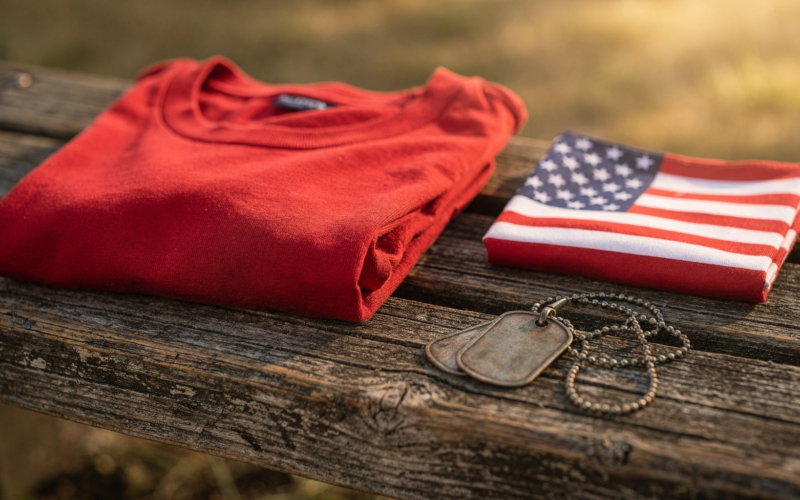
RED Friday trends every Friday and most people scrolling past it have no idea what the letters stand for. Remember Everyone Deployed. Wear red, every Friday, until every service member comes home.
It is one of the few internet rituals with a genuinely practical origin, and it exists because the people it was built for are living with a specific kind of absence that most advice about relationships does not address.
Where The Tradition Came From
The commonly told origin is an email chain that circulated among military families around 2005, encouraging people to wear red on Fridays as a visible show of support. Veterans organisations including Soldiers’ Angels have described it this way for years.
Other accounts place the origin later, and honestly the record is muddled. What is not disputed is that the practice spread through military families first and reached the general public afterward, which shapes what it actually means.
Visibility Is The Entire Point
A deployment is invisible to almost everyone around the family experiencing it. Neighbours do not know, colleagues forget, and the person at home spends months managing a household while fielding no acknowledgement at all.
A room with red shirts in it is a low cost signal that somebody noticed. That is a modest thing and the people on the receiving end consistently describe it as mattering far more than its cost would suggest.
It spread through predictable channels once it left the family networks. Exchange workers, veteran service organisations and local government offices adopted it, and the weekly cadence meant it never needed a campaign to stay alive. A tradition that repeats every seven days does not have to be remembered, only continued.
Deployment Is Not A Long Distance Relationship
The comparison gets made constantly and it is wrong in a way that causes real harm. Ordinary long distance couples control their communication. They can call when they want, plan visits, and know where the other person is.
Deployment removes all three. Contact windows are dictated by operations and time zones, plans collapse without notice, and communication blackouts happen for reasons that cannot be explained. Advice built for long distance dating does not transfer.
The Person At Home Is Also Doing Something Hard
There is a persistent cultural script where the deployed member is serving and the partner at home is waiting. The second half of that is inaccurate. The person at home is running a household alone, often with children, on a timeline nobody can confirm.
They also carry the emotional labour of managing everyone else’s worry, including extended family who want updates that do not exist. That is real work and it goes largely unrecognised.
Children complicate the arithmetic further. A parent explaining an indefinite absence to a five year old has to do it repeatedly, without a date, and without letting their own uncertainty show. That is a sustained performance with no intermission.
Reintegration Is The Part Nobody Prepares For
Homecoming footage ends at the airport. What follows is frequently harder than the separation, because two people who each adapted independently now have to merge routines that no longer match.
Household roles shifted. Decision making patterns changed. Both people grew in directions the other did not witness. Expecting to resume where you left off is the single most common mistake, and it sets up a disappointment that neither person anticipated.
What Actually Helps From The Outside
Specific offers beat general ones by an enormous margin. Saying let me know if you need anything transfers the work of asking onto someone already overloaded. Saying I am bringing dinner Thursday does not.
Practical help means childcare, a lawn, a car repair, a standing coffee. The people who show up in month four, after the initial wave of support has evaporated, are the ones families remember.
What Does Not Help
Asking where someone is deployed, when they are coming back, or whether they have seen combat puts a family in the position of declining to answer. Operational security is real and the question is unanswerable more often than people realise.
Speculating about the mission or sharing details you picked up secondhand is worse. So is treating a deployment as an opportunity to argue foreign policy with someone whose spouse is in it.
Every branch runs family readiness and support programmes, and military family life counsellors are available at no cost. Families consistently underuse them, often because asking feels like admitting the arrangement is not working, when in fact the programmes exist precisely because it is hard for everyone.
How To Take Part Without Making It About You
Wear the red, skip the caption about your own feelings, and pair it with something concrete. The hashtag works best as a prompt to do something rather than as the thing itself.
If you want the companion observance that recognises those already wounded rather than currently deployed, that falls on 7 August each year, which we covered in our piece on the real history of Purple Heart Day.
Frequently Asked Questions
What does RED Friday stand for?
Remember Everyone Deployed. Participants wear red every Friday as a visible show of support for service members currently on deployment.
When did RED Friday start?
Accounts vary. The most commonly cited origin is an email chain circulating among military families around 2005, though some sources place it later. The record is genuinely inconsistent.
Is RED Friday an official military observance?
No. It is a grassroots tradition that began with military families and spread outward. It has no official designation, which is part of why its origin is hard to pin down.
How is deployment different from long distance dating?
Deployed couples cannot control when they communicate, cannot plan reliably, and face blackouts that cannot be explained. Standard long distance relationship advice assumes control that does not exist here.
What should you not ask a military family?
Avoid asking about location, exact return dates, or combat experience. Those questions are frequently unanswerable for security reasons and put the family in an awkward position.
What is the most useful thing to offer?
Something specific and scheduled. Concrete help like a meal on a named day, childcare, or a household task beats an open ended offer to help if needed.