
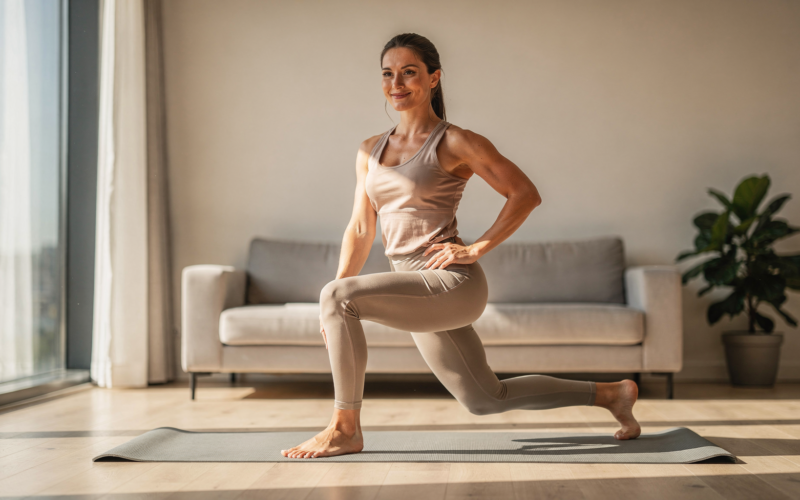
The idea that a good workout requires a gym full of equipment is one of the most persistent and unhelpful myths in fitness. The reality is that your own body provides all the resistance you need for an effective, challenging workout, and some of the fittest people around train with little more than the floor beneath them. Home workouts with no equipment remove the most common barriers to exercising, namely cost, travel time, and the intimidation many people feel at a gym, which makes them one of the most practical and sustainable ways to get and stay fit.
Bodyweight training is not a lesser alternative to lifting weights but a genuinely effective method in its own right, capable of building strength, endurance, and mobility. With a small amount of space and no special gear, you can put together a complete routine that works your whole body. This guide covers why it works and how to structure your own effective sessions at home. As always, checking with your doctor before beginning a new exercise routine is a sensible precaution.
Why bodyweight workouts work
Bodyweight exercises work because your muscles do not know or care whether the resistance they are working against comes from a dumbbell or from your own body. Movements that use your body as the load can effectively challenge your muscles, elevate your heart rate, and improve your coordination and control. Because you can adjust the difficulty by changing your leverage, speed, or range of motion, bodyweight training scales from complete beginner to very advanced, which means it can keep challenging you for years without a single piece of equipment.
The key movement patterns
A balanced home workout covers a few fundamental movement patterns, each of which has accessible bodyweight versions. Pushing movements, such as push-ups in their many variations, work the chest, shoulders, and arms. Lower-body movements like squats and lunges build the legs and glutes, which are the largest muscles in your body. Core exercises such as planks strengthen the midsection that stabilizes everything else. And getting your heart rate up through movements like jumping jacks, high knees, or simply moving quickly between exercises adds a cardiovascular element. Together, these patterns form the backbone of a complete routine.
Structure a simple workout
A straightforward and effective way to structure a home session is to begin with a few minutes of gentle warm-up to prepare your body, then move through a circuit of exercises covering the main movement patterns, and finish with a short cool-down and some gentle stretching. Working through several exercises with brief rests, then repeating the circuit a few times, gives you a full-body workout in a modest amount of time. You can adjust the number of repetitions, the length of rest, and the number of rounds to match your fitness level. The Move Your Way resources from the Department of Health and Human Services at health.gov offer helpful, approachable activity guidance.
Progress over time
One of the best things about bodyweight training is that it grows with you, so as exercises become easier, you can make them harder without any equipment. Increasing your repetitions, slowing down your movements to increase the time your muscles are working, reducing your rest, or progressing to more challenging variations of an exercise all keep your workouts effective as you get stronger. This built-in progression means you never plateau simply because you lack heavier weights, and it keeps home training engaging for the long term.
Keep it safe
Exercising safely matters as much at home as anywhere, and the golden rule is to prioritize good form over the number of repetitions. Performing an exercise with control and proper technique is both more effective and far safer than rushing through sloppy reps, which invites injury. Starting with beginner-friendly variations and progressing only when you can perform a movement well protects you, as does listening to your body and stopping if you feel sharp pain. Clearing a small, safe space free of obstacles and hazards before you begin rounds out a smart, injury-free approach.
Frequently asked questions
Can you get fit with no equipment?
Yes, absolutely. Bodyweight training uses your own body as resistance and can effectively build strength, endurance, and mobility. By adjusting leverage, speed, and range of motion, these exercises scale from beginner to advanced, so they keep challenging you over time. Many very fit people train with little or no equipment, proving that a gym is not required to get and stay in shape.
What are the best no-equipment exercises?
A balanced routine covers key movement patterns with exercises like push-ups for the upper body, squats and lunges for the legs and glutes, planks for the core, and movements like jumping jacks or high knees for cardio. Each has beginner-friendly variations. Combining these patterns into a simple circuit gives you an effective full-body workout using nothing but your body.
How do I make bodyweight exercises harder?
You can increase difficulty without equipment by doing more repetitions, slowing your movements to increase the time your muscles work, reducing rest between exercises, or progressing to more challenging variations of a movement. This built-in progression means bodyweight training keeps advancing your fitness over time, so you never plateau simply because you lack heavier weights at home.
How long should a home workout be?
A home workout can be effective in a modest amount of time, and consistency matters more than length. A session with a brief warm-up, a circuit of exercises repeated a few times, and a short cool-down works well. Beginners can start shorter and build up as fitness improves. Regular shorter workouts generally beat occasional long ones for building a lasting habit.
Your body is all you need
You do not need a gym, weights, or any special equipment to get a genuinely effective workout. With a little space and your own bodyweight, you can build strength, endurance, and mobility right at home, progressing steadily as you get fitter. Start with good form, keep it consistent, and let your workouts grow with you. If you are just getting going, see our guide on how to start exercising as a beginner, and learn how to stay motivated. Find more in the Exercise section. This article is general information and not a substitute for medical advice.



Comments 1
Comments are closed.