Back to school spending is setting a record this year, and the reason has almost nothing to do with your household. The National Retail Federation puts total K through 12 spending at a record $43.3 billion, up from $39.4 billion last year. The average family, meanwhile, plans to spend $863.86, which is about $6 more than last year. Both of those numbers are true and together they tell a story nobody is telling.
The Two Numbers Do Not Match
A record total with a flat average means the growth is not coming from families digging deeper. NRF’s per student figure moved from $858.07 to $863.86, an increase of less than one percent, which is behind almost any measure of price growth you want to use.
In real terms, the typical family is spending slightly less than last year. The record headline is arithmetic about how many people are shopping, not evidence that anyone got more generous.
Why Two Surveys Give You Wildly Different Answers
If the $864 figure sounds high, you are not imagining it. A separate Deloitte survey released in July landed near $570 per student, a gap of roughly $300 for supposedly the same question.
The gap is definitional. Some surveys count electronics, shoes and a new fall wardrobe. Others count pencils, notebooks and a backpack. Neither is wrong, but quoting one number as the cost of sending a kid to school is how parents end up feeling behind for no reason.
College Is the Actual Record
The number that deserves the alarm is the college one. NRF projects a record $103.5 billion in back to college spending, more than double the K through 12 total, and that figure excludes tuition.
Dorm furnishings, laptops, textbooks, a mini fridge and a printer nobody uses. It is the most concentrated burst of household spending most families do in a single fortnight, and it arrives right when tuition bills do.
Most Families Already Started
NRF found that the majority of shoppers had begun by early July. Front loading has become normal, driven by fear of stockouts and a general sense that waiting is punished.
That behavior has a cost. Buying in July means buying before the teacher’s actual supply list arrives, which is how you end up with the wrong binder size, the wrong calculator and a receipt that expired.
What Actually Reduces the Bill
Wait for the list. Not the store’s list, the teacher’s. Most of the duplicate spending in this category comes from guessing in July and buying again in September.
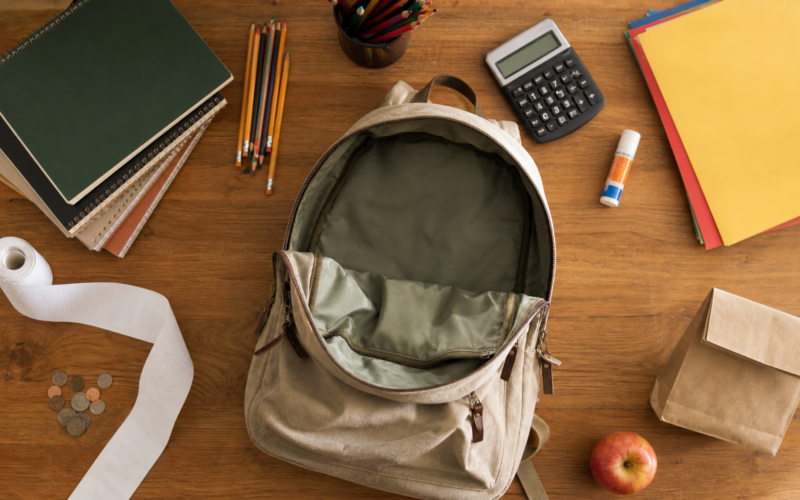
Then split it. Backpacks, lunch boxes, calculators and shoes are the durable items worth spending on, and consumables are worth buying cheap. Nobody’s academic outcome has ever hinged on a branded folder. Check your state’s sales tax holiday dates before you buy the expensive items, since the savings on a laptop can be real.
One more thing worth doing before you shop. Go through last year’s supplies first, because a startling amount of what gets bought in August is already in a drawer. Half used notebooks, unopened glue sticks, a perfectly good backpack that got replaced for reasons nobody can now articulate. Twenty minutes of inventory routinely takes fifty dollars off the list, and it is the only line item on this page you control completely.
The Line Item Nobody Budgets For
Fees. Activity fees, lab fees, instrument rental, athletics participation fees, field trips and the classroom supply request that arrives in week three. None of that is in the NRF number, and for many families it exceeds the supply list.
Ask the school office for the full fee schedule in August rather than discovering it in October. If it is beyond your budget, ask about waivers directly, because they usually exist and they are rarely advertised.
Where the Phone Rules Fit In
One thing genuinely different about this fall is the device policy. Restrictions on student phones have spread across most of the country, and the details vary by district in ways that affect what you actually need to buy, from a basic watch to a pouch to nothing at all.
We went through that shift in detail when your kid’s phone rules changed this summer. Read your district’s policy before you buy a device intended to solve a problem the policy may already have banned.
My Take on the Record Headline
Records make better headlines than context does. A record total driven by enrollment and participation, paired with a per family figure that is flat in nominal terms and down in real terms, describes households holding the line rather than splurging.
So if you feel like you are spending more and getting less, the data agrees with you. That is not a personal budgeting failure. It is what a flat number looks like after several years of price increases, and the retail industry has an obvious incentive to describe it as growth.
Frequently Asked Questions
How much are families spending on back to school in 2026?
NRF’s survey puts the average at $863.86 for families with elementary through high school students, up from $858.07 in 2025. Total K through 12 spending is projected at a record $43.3 billion.
Why do different surveys report such different amounts?
They count different things. Broader surveys include electronics, clothing and shoes, while narrower ones stick to classroom supplies. A separate Deloitte survey landed closer to $570 per student.
Is back to college spending really higher than K through 12?
Yes, substantially. NRF projects a record $103.5 billion for college students, more than double the K through 12 figure, and that total does not include tuition.
When is the best time to buy school supplies?
After the teacher’s specific list arrives, if you can wait. Buying in early July is how families end up purchasing the same item twice in different sizes.
What costs are missing from these estimates?
School fees. Activity, athletics, lab and instrument rental fees, plus field trips and mid semester classroom supply requests, are not counted and often rival the supply list itself.
Do sales tax holidays actually save money?
On large purchases like laptops and tablets, the savings are meaningful. On a $4 pack of pencils it is noise. Check your state’s dates and time the expensive items to them.