
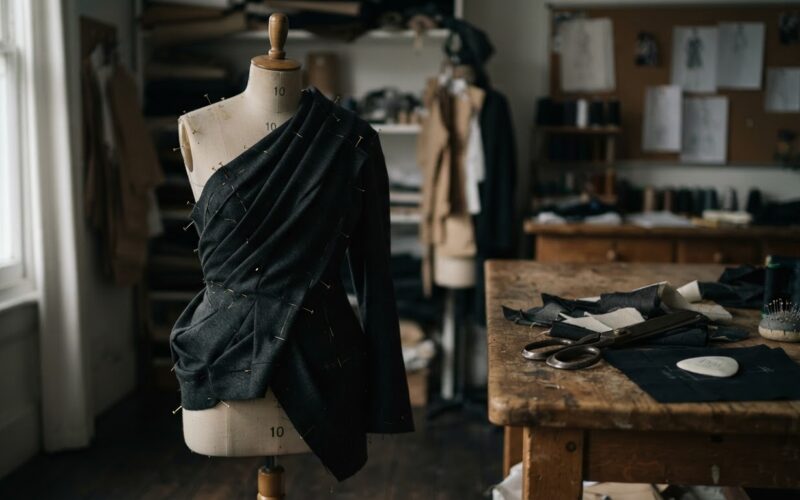
Taking over an American fashion house named after two other people is one of the least enviable jobs in the industry. Proenza Schouler was built on a specific downtown New York identity for two decades, and the founders’ departure left a brand with enormous name recognition and no obvious voice. Rachel Scott has now delivered her first full collection as creative director, and the interesting thing is that she did not try to imitate what came before.
Scott arrived with her own reputation already established. She founded Diotima in 2021 around a genuinely unusual premise, that some of the most valuable craft knowledge in the world sits in the Caribbean and has been treated as decorative rather than technical. That is not a marketing story bolted onto a brand. It is a design thesis, and it is the reason her Proenza Schouler debut reads as a point of view rather than a caretaker collection.
What The Fall 2026 Collection Actually Argues
The reporting from the collection describes structure balanced against softness, sculptural silhouettes and rich texture, with the trade press summarizing it as precise modern restraint. Translated out of fashion vocabulary, that means clothes with architecture in them that do not look armored. Restraint is the operative word and the riskiest choice. A debut collection is tempting to overload, because loud is easier to photograph. Choosing precision instead is a bet on customers rather than on coverage.
Presenting At A Retailer, Not On A Runway
Scott introduced the collection at Neiman Marcus Beverly Hills, previewing it for top clients rather than staging a traditional show. That detail is easy to skip past and worth pausing on. A runway sells the idea to editors. A retail preview sells the clothes to the people who actually buy them at full price. For a house rebuilding its commercial base, talking to the top of the customer list first is a strategic decision about who the brand needs to convince.
The Michelle Obama Moment Did Real Work
In July, Michelle Obama wore a custom Proenza Schouler design drawn from Scott’s first full collection. Fashion writers noted the resonance of a Black Jamaican woman leading an American house at that particular moment. Whatever you think of celebrity placement as a strategy, this one functioned differently from a paid look, because it demonstrated that the new Proenza Schouler could handle formal occasion dressing. That is a capability the brand needed to prove it still had.
Craft As Technical Argument, Not Heritage Styling
The distinction that makes Scott worth watching is how she treats craft. Plenty of designers reference artisanal technique as surface decoration, a hand finish applied at the end for storytelling purposes. Scott’s work at Diotima instead treated crochet, macrame and hand manipulation as construction methods that determine how a garment is built and how it moves. Carrying that into a house with Proenza Schouler’s manufacturing resources is the actual experiment here, and it is more ambitious than a new silhouette.
A New Chief Executive Changes The Math
Laura Weir was recently appointed chief executive, which means the brand is rebuilding both halves at once. That is either coherent or chaotic depending on execution. Creative directors fail most often when the commercial side is set up to sell a different brand than the one being designed. A simultaneous reset gives the design and business strategy a chance to agree with each other from the beginning, which is rarer than it sounds.
Why American Luxury Needed This
American fashion has spent years short on houses with a genuine design identity at the luxury tier. There is enormous strength in sportswear and in commercial ready to wear, and a persistent gap where a distinctly American luxury vocabulary should be. A house with existing recognition, new leadership and a designer whose ideas come from somewhere specific is exactly the setup that could fill that gap. Whether it does is a question of the next four collections, not this one.
The Founder Shaped Hole Is The Real Problem
Every house that loses its namesake designers faces the same trap, and most fall into it. The archive becomes a hostage. Customers who loved the original voice want continuity, the commercial team wants the bestsellers reissued, and the incoming designer gets pushed toward a tribute act that pleases nobody for long. It flatters the past and starves the future, and it is why so many second era collections feel like competent karaoke.
Scott appears to have refused that arrangement, which is the most encouraging signal in the whole debut. Building a new vocabulary inside an established name is slower and riskier than mining the archive, and it is the only approach that produces a brand with a future rather than a well managed estate. It also means the first year of reviews will be harsher than a nostalgia collection would have earned, and that cost has to be absorbed on purpose.
What To Watch Next
Scott’s sophomore collection is due at the next round of women’s fashion week, and second collections are where you learn whether a designer has a system or a mood. The debut established the vocabulary. The follow up has to prove the vocabulary can produce different sentences. I would also watch price positioning and how much of the hand work survives contact with production volume, because that is where craft driven design usually gets compromised.
Frequently Asked Questions
Who is Rachel Scott?
A Jamaican designer who founded the label Diotima in 2021 around Caribbean craft technique, and who now serves as creative director of Proenza Schouler.
When did she debut at Proenza Schouler?
Her first full collection is Fall 2026, which she presented to clients at Neiman Marcus Beverly Hills rather than through a conventional runway show.
Did Michelle Obama wear the collection?
Yes. In July she wore a custom design drawn from Scott’s first full collection for the house, which drew significant coverage.
Is Diotima still operating?
Scott’s own label remains her original platform, and it is where the craft driven approach she is bringing to Proenza Schouler was developed.
Who runs Proenza Schouler now?
Laura Weir was recently appointed chief executive, working alongside Scott as creative director in what amounts to a simultaneous reset of both sides of the business.
When is her next collection?
Her sophomore collection is expected at the next women’s fashion week cycle. For context on where luxury is heading, read our piece on the fading quiet luxury era.