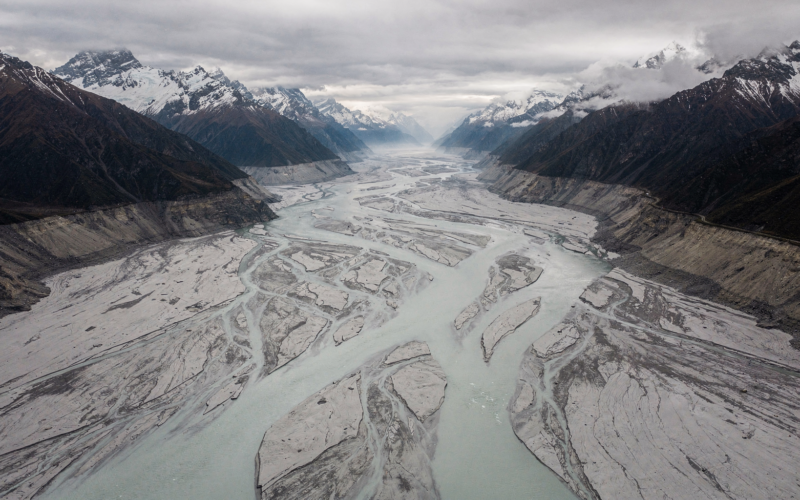
A section of Himalayan glacier collapsed Wednesday morning, sending an avalanche of ice and rock into Tibet’s Lhende River. The debris dammed the river, the dam burst, and the resulting flood has killed at least 157 people in Nepal and three in Tibet, with roughly 1,500 people still missing.
Those numbers are moving. Nepali counts published within hours of each other have differed between 157 and 162, and the missing total includes an estimated 800 foreign nationals. Treat every figure here as accurate to Thursday morning and expect it to change.
What Actually Happened
The collapse occurred around 8:40am local time. A mass of ice and rock detached high on the mountain and fell into the valley below, landing in the river.
That impact created a temporary natural dam. Water backed up behind it, and when the debris gave way the accumulated volume released at once. A flood produced this way behaves very differently from rainfall flooding, arriving as a single destructive surge rather than a rising level.
It Was Not an Earthquake
Early reports described a magnitude 4.4 earthquake as the trigger. The United States Geological Survey has since clarified that the seismic signal was generated by the landslide itself rather than causing it, and registered at magnitude 5.2.
The distinction matters for understanding the event. Large mass movements produce seismic signatures that instruments record as quakes, and in the first hours of a disaster that reads backwards. Nothing shook the mountain loose. The mountain coming loose is what shook.
Who Is Missing
Roughly 1,500 people are unaccounted for, and an estimated 800 of them are foreign nationals. Reported figures include about 133 Indian pilgrims travelling toward Mount Kailash, 47 Americans, 34 Australians, 33 British and 24 Canadians.
The pilgrimage route explains the concentration. Mount Kailash is a major destination for Hindu, Buddhist, Jain and Bon pilgrims, and late August sits inside the season when the crossing is passable.
Why Missing and Dead Are Counted Separately
In a flood through steep terrain, the distinction is largely about access rather than hope. Roads and bridges are gone, communications are down, and search teams cannot reach much of the affected length of river.
People also scatter. Some who are listed as missing walked out on their own and have not been able to contact anyone. Others will be recovered over days or weeks. The number that eventually settles is usually well below the peak missing count and well above the early confirmed dead.
This Has Happened Before on This River
It is the second event of this kind on the same river system in fourteen months. That is the detail that turns this from a tragedy into a pattern.
Glacial lake outburst floods and ice collapses have become more frequent across the Himalaya as glaciers retreat and destabilize. Meltwater pools behind unstable natural dams, and warming permafrost loosens the rock that holds slopes together. The region has thousands of such lakes and only a fraction are monitored.
Why Warning Systems Fail Here
The physics leave almost no margin. A flood generated by a dam burst in steep terrain reaches downstream settlements in minutes, not hours, and the collapse itself happens without a meaningful precursor anyone can detect.
Even where monitoring exists, the warning has to travel through mountain communications infrastructure that the flood is in the process of destroying. Building systems that work under those conditions is expensive and technically difficult, and neither country has installed them along most of the vulnerable valleys.
What the Response Looks Like
Both Nepal and China are conducting operations on their side of the border. Helicopters are the primary tool, because the roads are gone and terrain access is limited even for people on foot.
Foreign nationals among the missing means multiple governments are now involved in a coordination problem across a contested border. Disaster response through fractured institutions is difficult everywhere, and our coverage of the Kenscoff attack in Haiti looked at what happens when the machinery is not there at all.
What to Watch Next
Watch the missing number, which is the one that will move most. Watch whether the river has formed any additional debris dams upstream, because a second release into an already devastated valley is the immediate danger.
And watch for identification of the foreign nationals, which is what will bring international attention and, with it, resources. Americans among the missing means the State Department will be engaged, and that engagement usually becomes public within days.
One more piece of context about why this region keeps producing these events. The Himalaya holds more ice than anywhere on earth outside the poles, and it feeds rivers that something like two billion people depend on.
As that ice retreats it leaves behind meltwater pools held back by loose moraine rather than by bedrock, and the permafrost binding the surrounding slopes weakens at the same time. Both processes accelerate together.
Which means these are not freak accidents. They are the predictable output of a system changing state, and the number of unmonitored lakes across the range is large enough that the next one is a matter of timing rather than possibility.
Frequently Asked Questions
What caused the flooding?
A section of Himalayan glacier collapsed Wednesday morning, sending ice and rock into Tibet’s Lhende River. The debris dammed the river and the dam then burst, releasing a single destructive surge downstream.
How many people have died?
At least 157 in Nepal and three in Tibet as of Thursday morning. Counts have varied between outlets and the total is expected to rise.
How many are missing?
Roughly 1,500, including an estimated 800 foreign nationals. Reported figures include about 133 Indian pilgrims, 47 Americans, 34 Australians, 33 British and 24 Canadians.
Was there an earthquake?
No. Early reports of a magnitude 4.4 earthquake were wrong. The US Geological Survey says the landslide itself generated the seismic signal, at magnitude 5.2.
Why were so many foreigners there?
The area sits on the pilgrimage route toward Mount Kailash, a major destination for Hindu, Buddhist, Jain and Bon pilgrims, and late August falls within the season when the crossing is passable.
Has this happened before?
Yes. It is the second event of this kind on the same river system in fourteen months. Glacial collapses and outburst floods have grown more frequent across the Himalaya as glaciers retreat.