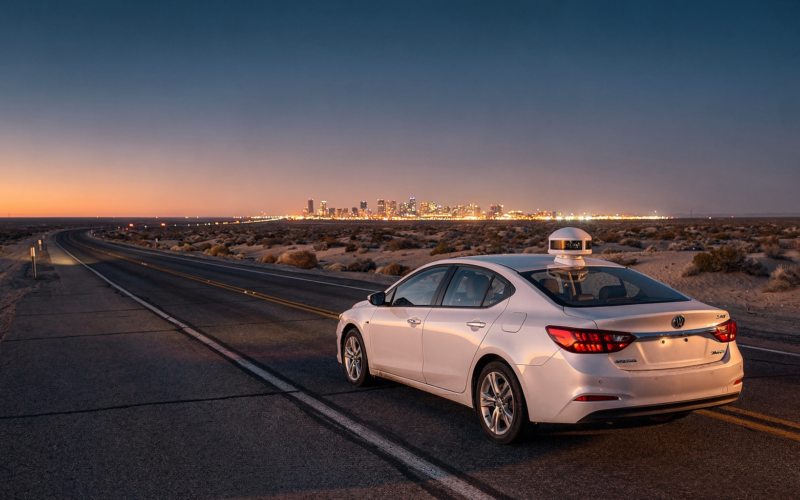
The Nevada Transportation Authority voted unanimously Thursday to approve commercial robotaxi permits in Clark County, clearing up to 8,000 paid driverless vehicles across three operators. Tesla got the largest allocation at 5,000, with Waymo approved for 1,000 and Uber for another 1,000 through its Motional and Zoox partnerships.
It is the largest single robotaxi authorization in the United States, and it makes Las Vegas the most permissive autonomous vehicle market in the country by a wide margin. It also does not mean 8,000 driverless cars are about to appear on the Strip.
What the Vote Actually Approved
The permit is an Autonomous Vehicle Network Company authorization, which is the full commercial license allowing paid rides. That is a different and much larger step than the testing permits that preceded it.
The numbers are ceilings, not deployments. An operator approved for 5,000 vehicles is permitted to run up to that many, and has to actually build, deliver, insure and support each one before any of them carries a paying passenger.
The Confusion About Tesla’s Number
Earlier reporting this month said Tesla had asked for 5,000 vehicles and been granted 10. That was accurate at the time and described a provisional permit at the testing stage. Thursday’s vote is the full commercial authorization.
This is worth stating clearly because the two stories look contradictory and are not. It is an escalation across two steps of the same process, and anyone framing it as a reversal has skipped the middle.
Tesla Is Managing Expectations
Tesla’s chief engineer moved almost immediately to tamp down the number, calling 5,000 a ceiling and saying the company would be extremely happy to reach 2,500 within a year. That is a notable gap between what was approved and what is expected.
The caution is warranted. Scaling a driverless fleet is constrained by vehicle production, depot capacity, charging infrastructure, remote support staffing and local operations, none of which move at the speed of a regulatory vote.
Why Las Vegas
The geography is close to ideal. The road grid is wide and regular, the weather is dry and predictable almost year round, and the highest value trips run along short, repetitive corridors between the airport, the Strip and the convention center.
The demand profile helps too. Las Vegas runs on visitors who do not have cars, arrive in waves around events, and need short trips at unusual hours. That is close to the perfect early market for a service that has trouble with long unpredictable routes.
What Riders Should Expect
In practice, rollout will be gradual and geofenced. Operators typically open a limited service area, expand it in stages, and keep human remote support available for situations the vehicle cannot resolve on its own.
Pricing is the open question nobody has answered. Removing the driver removes the largest cost in a ride, but the vehicles, sensors, depots and remote operations are expensive, and early pricing has historically tracked existing rideshare rates rather than undercutting them.
What It Means for Drivers
This is the part with real consequences for real people. Las Vegas supports a large population of rideshare and taxi drivers, and short high frequency trips in a compact area are precisely the work most exposed to automation.
The displacement will not be sudden, because deployment will not be sudden. But 8,000 authorized vehicles in a single metro is a scale that changes the arithmetic of driving for a living there, and no plan for that has been announced by anyone.
The Safety Framework
Nevada has been permissive on autonomous vehicles for over a decade and built regulatory machinery around it early. The state’s approach leans on operator reporting and incident review rather than prescriptive vehicle requirements.
Whether that framework holds at this scale is genuinely untested. Every existing robotaxi safety record comes from fleets far smaller than what was just authorized, and safety statistics behave differently when the denominator grows. The pace of change in AI systems generally, including the models underneath these vehicles, has been hard to track this year, as our piece on the unclaimed Ox Alpha model illustrated.
What to Watch Next
Watch the actual deployment count rather than the permit ceiling, because those two numbers are going to diverge sharply. Watch the initial service area boundaries, which reveal what the operators think they can handle.
Watch also whether other states treat Nevada as a template. Regulatory approaches in this field spread by imitation, and the largest authorization in the country is now the most visible example available.
The other question nobody is asking loudly enough is what happens to the physical infrastructure of the city. Eight thousand authorized vehicles implies depots, charging capacity, maintenance bays and staging areas, none of which exist yet at that scale in Clark County.
Those facilities have to go somewhere, and where they go is a local land use question that has barely started. Robotaxi fleets need parking between trips in a way that human driven rideshare does not, because a human driver goes home and an autonomous vehicle has to be stored, cleaned and charged somewhere specific.
There is also the matter of what happens during the events that define the city. Las Vegas regularly absorbs conventions that add a hundred thousand people to a compact area over a few days, and traffic behavior during those windows is nothing like a normal Tuesday. How autonomous fleets handle that congestion is untested at any scale, and the first big convention after deployment will be more informative than any amount of testing.
Frequently Asked Questions
How many robotaxis were approved?
Up to 8,000 across three operators in Clark County: Tesla up to 5,000, Waymo up to 1,000, and Uber up to 1,000 through Motional and Zoox.
Are 8,000 driverless cars coming right away?
No. Those are permit ceilings, not deployment plans. Tesla’s chief engineer said the company would be extremely happy to reach 2,500 within a year.
Did Tesla get 10 vehicles or 5,000?
Both, at different stages. The earlier figure of 10 was a provisional testing permit. Thursday’s vote granted the full commercial authorization for up to 5,000.
Why Las Vegas?
A regular road grid, consistent dry weather, and a visitor economy built on short repetitive trips between the airport, the Strip and the convention center make it unusually well suited.
Will rides be cheaper?
Unknown. Removing the driver removes the largest cost, but vehicles, sensors and remote operations are expensive, and early robotaxi pricing elsewhere has tracked existing rideshare rates.
What happens to rideshare drivers?
Short high frequency urban trips are the work most exposed to automation. Displacement will be gradual because deployment is gradual, but no transition plan has been announced.