
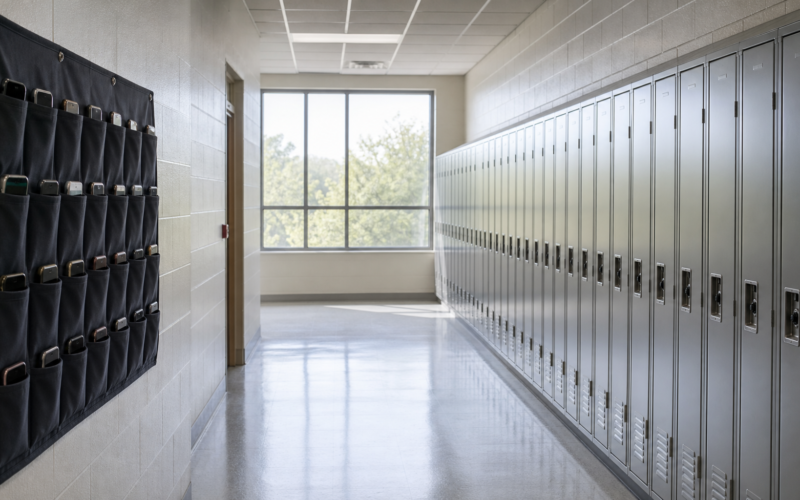
If you assumed your child’s school cellphone policy is the same one that was in place last spring, there is a reasonable chance you are wrong. A remarkable amount of this changed over the summer, mostly in July, mostly without the kind of direct communication that would actually reach a working parent. The result is that a lot of families are going to discover the new rules on day one, in the parking lot, from a kid who is upset.
The pace of change accelerated in July
Illinois signed a school cellphone restriction into law in late July, requiring districts to implement bans on electronic communication devices in time for the 2027-28 school year. Texas schools are already operating under a ban, with districts working through the practicalities of enforcement. Colorado passed a law that required every district to adopt a cellphone policy without mandating what that policy had to say. State lawmakers in a number of other places have been introducing legislation aimed at classroom screen time for younger students. This is no longer a handful of pilot programs.
Colorado shows what a patchwork actually looks like
The Colorado approach is the most instructive, because requiring a policy without specifying one produces exactly what you would expect. Among the state’s twenty largest districts, five adopted a bell to bell ban covering all grades, meaning no phones from the first bell to the last. Eleven took a narrower approach. That means two families living twenty minutes apart, both technically complying with the same state law, can be operating under completely different rules. If you moved districts, changed schools, or your child is transitioning to middle or high school, assume nothing carries over.
Bell to bell is a genuinely different policy
Parents often hear ban and picture what most schools have done for a decade, which is no phones during instruction. Bell to bell is a much bigger change. It covers passing periods, lunch, study hall and the gaps where teenagers have historically done most of their social coordination. Practically, it usually means a pouch, a locker or a classroom caddy, and it means your child cannot text you at 11:40 about a changed pickup time. That is the part that catches families off guard, and it is the part worth planning around before school starts rather than after.
The evidence is real but narrower than the rhetoric
Honesty is useful here. There is legitimate research interest in this, including a recent cross sectional study published in JAMA Pediatrics examining state level limitations and exemptions on student cellphone use. But the public debate frequently overstates what is settled. The strongest claims tend to concern attention and classroom disruption. The broader claims, that removing phones will substantially fix adolescent mental health, are considerably less established. Reasonable educators disagree, and coverage has noted the open question of whether restrictions improve learning or mainly just limit access.
The objection parents actually raise
The most common parental resistance is not about screen time at all. It is about emergencies. Parents who want to reach a child during a lockdown, a medical situation or an unexpected schedule change find bell to bell rules genuinely frightening. Schools generally answer that emergency communication should route through the office, and that during an actual crisis a few hundred students texting simultaneously creates chaos and can endanger them. Both positions are defensible. What matters is knowing your specific school’s emergency procedure before you need it.
Exemptions exist and are easy to miss
Nearly every policy carves out exceptions, most commonly for students with documented medical needs like continuous glucose monitoring, students with disabilities whose accommodations involve a device, and English learners using translation tools. These exemptions usually require paperwork submitted in advance, and they are frequently buried in a handbook nobody reads. If your child has a plan in place, confirm in writing that it survived the policy change, because a substitute teacher confiscating a diabetes monitoring device is a bad afternoon for everyone.
Enforcement decides whether any of this works
The policy on paper matters far less than who is responsible for applying it. Districts that leave enforcement to individual teachers tend to produce wildly inconsistent results, because a teacher choosing between confiscating a phone and teaching a lesson will usually teach the lesson. Districts that use a physical system, whether pouches, lockers or classroom caddies, remove the daily negotiation entirely but add cost and logistics. Coverage of how Texas districts are handling their ban has focused almost entirely on this practical question rather than the principle behind it. Ask your school which model it chose, because that single answer tells you more about your child’s actual day than the wording of the policy does.
What to do in the next two weeks
Read the actual policy rather than a summary. Find out the specific storage method, because a pouch you cannot open yourself is a different experience than a locker. Establish an alternate contact routine with your child that runs through the front office, and rehearse it once so it is not theoretical. Confirm any accommodation paperwork. And decide in advance how you will handle a confiscation, because reacting to that in the moment tends to go badly. None of this requires you to have an opinion on whether the policy is correct. It requires you to know what it is.
Frequently asked questions
What is a bell to bell phone ban?
It prohibits phone use for the entire school day, including passing periods and lunch, rather than only during instructional time.
Did Illinois ban phones in schools?
Illinois signed a law in late July requiring districts to implement bans on electronic communication devices in time for the 2027-28 school year.
How do I contact my child during the day now?
Most policies route communication through the front office. Confirm your school’s specific procedure and practice it with your child before the first day.
Are there exceptions to these bans?
Typically yes, for documented medical devices, disability accommodations and translation needs, though these usually require paperwork submitted in advance.
Does banning phones improve academic outcomes?
Evidence is strongest on classroom attention and disruption. Broader claims about mental health effects are much less settled, and educators genuinely disagree.
Why did my district choose a different rule than the next one over?
Several states required districts to adopt a policy without dictating its contents, so neighboring districts under the same law can land in very different places.
The other line item quietly reshaping the back to school budget is where families are buying clothes, and the secondhand market has become genuinely enormous.