The necktie has spent fifteen years being written about as a corpse. Fall 2026 fashion trends have quietly resurrected it, and the interesting part is where it turned up. Not in boardrooms, which mostly stopped requiring one, but on runways and on people wearing it with knitwear, denim and no jacket whatsoever. The tie came back the moment it stopped being mandatory, which is how these things almost always work.
What the Collections Actually Showed
Trade coverage of the season put nineties sport, denim and the return of the tie among the defining threads. Alongside that runs a broader preppy current, with American classics like V necks, rep stripes and cable knits turning up in European collections and being written about as newly arrived. Fashion has a long habit of exporting American sportswear and selling it back with different buttons, and this season is a fairly pure example.
Why the Tie Could Only Return Now
An item cannot be styled ironically while it is still compulsory. The tie was a uniform requirement for so long that wearing one communicated obligation rather than choice. Now that almost no workplace demands it, putting one on reads as a decision, and decisions are what personal style is made of. The same thing happened to the suit, to the loafer, and to the button down shirt in turn.
The Preppy Revival Is Not Nostalgic
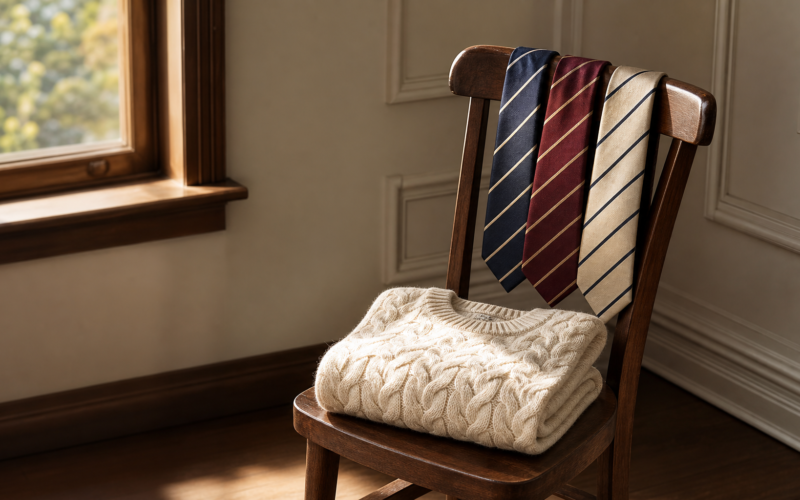
Worth distinguishing between wearing preppy clothes and wearing preppy references. The current version is mostly the latter. The rep stripe appears without the club it referred to, the cable knit arrives oversized rather than fitted, and the whole vocabulary is being borrowed for texture and color rather than for the social signaling it originally carried. That is the difference between a costume and a trend.
The Color Story Is Loud
Season previews point toward bold, saturated color rather than another year of muted neutrals, expressed through tactile texture and paired with animal print in a genuinely maximalist direction. This is a real reversal. After several seasons of quiet luxury and beige as a personality, the pendulum is swinging hard, and it is arriving at the same moment interiors are making the identical move away from gray.
What the Buyers Are Actually Buying
Shopping editors have been unusually blunt about what they are backing this season. Satin is on the buying list. Two tone shoes are on the buying list. Linen and wedges are on the skip list, which is a seasonal call rather than a permanent verdict. That distinction between the trends people write about and the trends people spend on is usually where the useful information lives.
Menswear is driving more of this than usual. The tie, the rep stripe and the nineties sport references all originate in men’s wardrobes, and womenswear collections are borrowing them close to wholesale rather than adapting them. That direction of travel reverses the pattern of recent seasons, when oversized tailoring moved the other way. It also means the pieces arriving now were built to a different fit standard, which is worth knowing before you order your usual size in something described as borrowed from the boys.
Layering Is the Technical Story
The more practical development is that layering has gotten directional rather than additive. Instead of stacking pieces for warmth, collections are using layers for proportion, with length and volume deliberately mismatched. That is harder to execute than it sounds and it is where most people go wrong, because the instinct is to keep adding rather than to let one layer be obviously longer or looser than the one beneath it.
The accessory story extends well past the neck. Collections leaned on hardware, brooches and visible closures as decoration rather than function, which is the sort of detail that reads as fussy on a rail and considerably better in motion.
How to Wear a Tie Without Looking Employed
The failure mode is dressing like you are on your way to a deposition. The current styling separates the tie from its usual companions. Wear it with a knit rather than a blazer, loosen the knot rather than pulling it tight, or use a narrower silk with an open collar. Pattern helps too, because a rep stripe reads as reference while a plain navy reads as uniform.
What Actually Survives to Spring
Most of this will not last, and that is fine. The pieces with staying power are the ones that were already in circulation before the season named them, which is the cable knit and the good denim. The tie is a genuine question mark. It could be a one season novelty or the start of a longer accessory cycle. Either way it belongs in the category of things worth buying once rather than in quantity, which is increasingly how stylists are telling people to build a fall wardrobe.
Frequently Asked Questions
Are neckties actually back in fashion?
On runways and in editorial styling, yes, listed among the season’s defining trends. In workplaces they remain largely optional, which is precisely why the item became interesting again.
What defines the fall 2026 preppy revival?
V necks, rep stripes and cable knits borrowed as references rather than worn as a complete look, frequently mixed with denim and nineties sportswear elements.
What colors are dominant this fall?
Bold and saturated rather than neutral, delivered through tactile textures and often combined with animal print in a maximalist direction that reverses several quiet seasons.
Which trends are editors skipping?
Shopping editors have publicly passed on linen and wedges for the season while backing satin and two tone shoes, which is a seasonal judgment rather than a permanent one.
How do you wear a tie casually?
Pair it with knitwear instead of a blazer, keep the knot loose, and choose pattern over plain. A rep stripe with an open collar reads as a styling choice rather than a dress code.
Is quiet luxury over?
The direction has clearly shifted toward color and maximalism for fall. Restrained neutral dressing has not disappeared, but it is no longer the default the industry is pushing.