
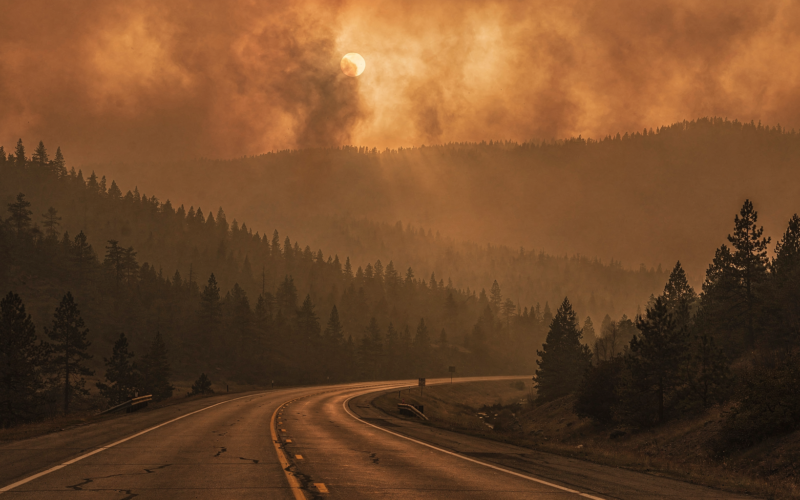
Oregon wildfires have moved past a million acres burned this season, with dozens of large active fires and no immediate sign of the pattern breaking. The number that keeps changing is the acreage, and the number that keeps affecting people who do not live in Oregon is a highway. Interstate 84 has closed and reopened repeatedly across eastern Oregon in the last several days, and officials are warning that more closures should be expected.
The scale, with appropriate uncertainty
Reported totals vary, which is normal in an active season and worth stating plainly rather than smoothing over. Multiple outlets have described more than a million acres consumed statewide, one tracking figure put it above 1.1 million, and at least one Oregon newspaper reported roughly 1.5 million acres with additional homes lost. The variation reflects different counting methods and the lag between perimeter mapping and publication. The safe reading is that this is a season well past a million acres and still growing.
Interstate 84 is the part with national consequences
I-84 closed on July 27 between Baker City and Ontario because of dangerous fire conditions, with the affected stretch described in the range of 70 to 80 miles. It has since reopened, though at points only one westbound lane was moving, and a roughly 30 mile section between the same two towns has continued to see delays and intermittent closures. Sections of Highway 20 and Highway 26 have also been affected, and there was a separate reported closure much further west at Cascade Locks.
Why a single highway closure matters this much
I-84 is not a scenic route. It is the primary east-west freight corridor connecting Portland and the Columbia River to Idaho and the interior West, and there is no convenient parallel alternative through that terrain. Closing it does not add twenty minutes, it adds hundreds of miles to long-haul routing. That shows up as delayed deliveries, drivers running out of legal hours in the wrong place, and cost increases that eventually reach shelves far from Oregon. Highway 20 and Highway 26 are the natural detours, which is precisely why their own closures compound the problem.
Homes are being lost without much attention
At least six homes have been destroyed on one blaze alone, with additional structures lost elsewhere, and crews have been working specifically on structure protection. Six homes will not lead a national broadcast, and for the six households involved it is total. This is the routine cruelty of a bad fire season in a rural state. The losses are distributed thinly enough across a large area that they never aggregate into a single headline, which tends to mean the recovery gets less attention than the emergency did.
Heat is making the fight harder
The fires are burning into an extended heat pattern rather than out of one. Conditions have been hot enough that some schools released students early because of temperature, which gives a sense of the environment crews are working in. Extreme heat degrades firefighter performance, dries fuels faster than crews can build containment, and makes overnight relief, when humidity normally recovers and fire behavior moderates, far less reliable. A fire season inside a heat wave is a materially different problem than the same fires in ordinary summer weather.
The smoke travels much further than the fire
The fire perimeter is a local problem and the smoke is a regional one. Coverage this week has described wildfire smoke blanketing multiple states, which is the part of a season like this that reaches people who will never see a flame. Fine particulate matter from wildfire smoke is the specific hazard, and it disproportionately affects children, older adults, pregnant people and anyone with asthma or heart disease. It also has an unpleasant interaction with the current heat, because the standard advice for smoke is to stay indoors with windows shut while the standard advice for heat in homes without air conditioning is to open them. Households facing both at once are being asked to follow contradictory guidance.
What officials are actually telling people
The guidance has been unusually direct. Local advisories have told travellers to expect continued or additional I-84 closures and not to rely on that route in the coming days. That is a stronger statement than the usual check-conditions boilerplate, and it should be read as intended. If your route crosses eastern Oregon this week, plan around the corridor rather than through it, and check state transportation updates the morning you travel rather than the night before, since these closures have been opening and shutting within hours.
What to watch over the next week
Three indicators. Whether the upper level heat pattern relaxes, because containment progress in these conditions depends more on weather than on resources. Whether closures shift westward toward the Columbia River Gorge, which would affect a far larger population and a busier stretch of I-84. And whether the number of active large fires falls, since dozens of simultaneous incidents split crews, aircraft and equipment across too many fronts. A season stops getting worse when the incident count drops, not when a single fire is contained.
Frequently asked questions
How much of Oregon has burned in 2026?
Reports place the statewide total above one million acres, with some accounts citing 1.1 million and at least one reporting roughly 1.5 million. The figure continues to rise.
Is Interstate 84 open right now?
It has reopened between Baker City and Ontario after closing on July 27, but delays and intermittent closures continue and officials expect more.
Why does the I-84 closure matter beyond Oregon?
It is the main east-west freight corridor linking Portland to Idaho with no convenient parallel route, so closures add hundreds of miles to trucking.
Which other highways are affected?
Sections of Highway 20 and Highway 26 have seen closures and delays, and a separate closure was reported at Cascade Locks further west.
Have homes been destroyed?
Yes. At least six homes were lost on a single fire, with additional structures destroyed elsewhere as crews focus on structure protection.
What should travellers do this week?
Avoid routing through eastern Oregon if possible, and check state transportation updates the morning of travel rather than the night before.
The atmospheric setup driving this heat is the same one keeping the Atlantic strangely quiet, and that combination is worth understanding.