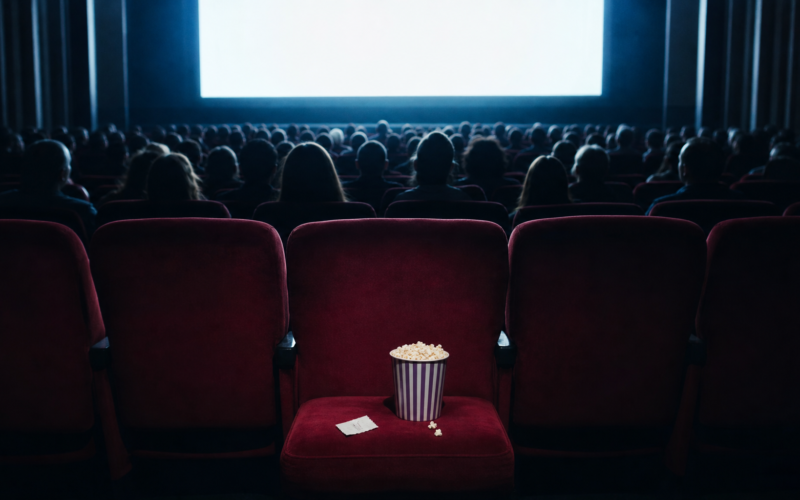

America is running out of places to simply be. Movie theaters, bowling alleys and neighborhood bars have been closing at a pace that recent reporting describes as structural rather than cyclical, and the buildings that replace them rarely invite anyone to linger. Meanwhile a whole industry has appeared to sell the thing those places used to provide for the price of a beer.
The sociologist Ray Oldenburg called them third places, the spots that are neither home nor work where community accidentally happens. They are disappearing, and the market has noticed the vacancy.
What Is Actually Closing
The category is broader than nostalgia suggests. Independent cinemas, bowling alleys, diners, dive bars, arcades, community pools and small bookstores share an economic profile that has become nearly impossible. They occupy expensive square footage, they earn thin margins per visitor, and their core value proposition is that people stay a long time without spending much. Commercial rent does not reward that. A drive through with no seating earns more per square foot than a room where people talk for two hours.
Access Was Never Distributed Evenly
Research on third place access has found substantial geographic disparities, meaning the closures land hardest where options were already thin. A dense walkable neighborhood losing one cafe still has four. A suburb losing its bowling alley may have lost the only indoor place a teenager could go without a car and a credit card. When people talk about loneliness as a national condition, this distribution is doing a lot of the explanatory work that personality and phones usually get blamed for.
The phone gets blamed for all of this and the phone deserves some of it, but the timeline does not line up as neatly as the argument requires. Plenty of the closures trace back to commercial rent, insurance costs and a labor model that stopped working long before anyone was scrolling at a bar. A screen is a very convenient replacement for a place that no longer exists, which is different from being the reason it closed.
The Paid Social Club Boom
Into that gap walked membership clubs, curated dinner series, paid run clubs and friendship matching apps. The pitch is efficient, and the appeal is obvious to anyone who has tried to make friends after thirty. Someone else handles the logistics, the invitations and the awkward first ten minutes. Researchers examining these models are skeptical that they solve loneliness, and the reasoning is sound. Belonging is built by repetition and low stakes familiarity, not by a curated evening with strangers who paid the same fee.
Cost Turns Community Into a Product
The obvious problem with paid connection is that it prices out exactly the people most affected by the closures. A membership at a few hundred dollars a month is a rounding error for one household and impossible for another. When the free version of a thing disappears and the paid version replaces it, what looks like a market solving a problem is often a market sorting a population. That is worth naming plainly, even while acknowledging that plenty of people have genuinely made friends this way.
Run Clubs Got There First and Free
The most interesting counterexample is the running club, which spread across cities largely without a business model. Show up at a corner, run a few miles, get a coffee, come back next week. It works because it has the three ingredients that matter. It repeats on a schedule, it gives people something to do besides talk, and it costs nothing to try. Hiking groups, community gardens, board game nights at libraries and church basement everything all run on the same engine.
Why Repetition Beats Intensity
Friendship research keeps landing on the same unglamorous finding. Proximity plus repetition produces relationships, and neither charisma nor shared interest substitutes for showing up in the same room on a schedule. That is precisely what a third place manufactures and precisely what a one off event cannot. It is also why work friendships form so easily and then evaporate when someone changes jobs. The building was doing more of the work than anyone realized.
What Cities Could Actually Do
This is a zoning and rent story more than a cultural one, which means it has levers. Permitting that favors mixed use ground floors, tax treatment that does not punish long dwell time businesses, real investment in libraries and community centers, and public space designed for sitting rather than moving through. Libraries in particular are the last widely available third place in America, they are already funded, and they are quietly absorbing demand that has nowhere else to go.
What You Can Do This Month
Pick something that repeats. Not an event, a recurrence. The weekly trivia night, the Saturday run, the volunteer shift, the same coffee shop at the same hour until the staff nod at you. Give it eight weeks before deciding whether it worked, because the first four will feel like nothing is happening and that feeling is not evidence. And spend money at the places that let people linger, because their business model depends on exactly the behavior you are trying to preserve.
That same logic explains why hiking groups keep absorbing social life, since they combine a standing schedule with an activity that makes conversation optional.
Frequently Asked Questions
What is a third place?
A term for the informal public spaces that are neither home nor work, such as cafes, bars, libraries, barbershops and community centers, where casual social contact happens.
Why are they closing?
Rent and margin pressure. Businesses built around people staying a long time and spending little earn less per square foot than formats designed for speed and volume.
Do paid social clubs work?
They help some people meet others, but researchers doubt they address loneliness broadly, largely because belonging depends on repetition and accessibility rather than curation.
Why do run clubs succeed?
They repeat weekly, cost nothing to try and provide an activity, which removes the pressure of having to be socially impressive on arrival.
Are libraries still a third place?
Yes, and they may be the most important remaining one. They are free, open to everyone and increasingly absorbing needs that other institutions no longer meet.
How long does it take to make friends somewhere new?
Longer than most people allow. Repeated low stakes contact over a couple of months tends to matter more than the quality of any single interaction.