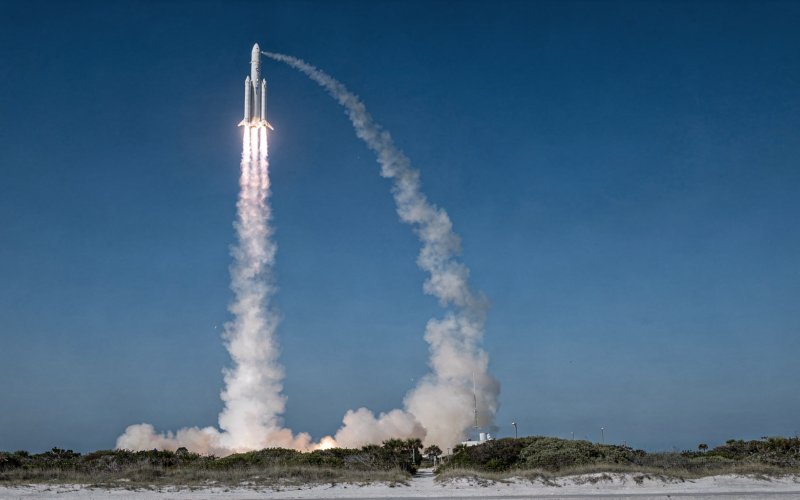
NASA’s Nancy Grace Roman Space Telescope left Earth at 7:26 a.m. Eastern this morning on a SpaceX Falcon Heavy, and about 31 minutes later it separated from the upper stage on a clean trajectory. It carries a mirror the same size as Hubble’s and a camera that sees roughly 100 times more sky in a single exposure. Over the next five years it is expected to catalog 20 billion stars.
The Launch
Liftoff came from Launch Complex 39A at Kennedy Space Center in Florida on Sunday, August 30, 2026. SpaceX confirmed a nominal orbit insertion, and the observatory separated from the upper stage roughly half an hour after leaving the pad.
The Falcon Heavy flew in its usual configuration: three cores, 27 Merlin engines, and what NASA describes as more than five million pounds of thrust. Both side boosters returned for landings at Cape Canaveral Space Force Station. The center core was expended, which is standard when a payload needs this much energy.
Where It Is Going
Roman is now on a cruise of about a month to a halo orbit around the second Sun Earth Lagrange point, roughly 930,000 miles to one million miles from Earth. That is the same neighborhood the James Webb Space Telescope occupies.
The appeal of that location is thermal stability. Earth and the Sun stay in the same direction, so a sunshield can block both at once and the instruments can sit cold and undisturbed. It is also far enough out that servicing is not realistic, which raises the stakes on the deployment sequence.
A Mirror With an Unusual History
The primary mirror is 2.4 meters across, identical in diameter to Hubble’s, but the whole observatory is roughly 80 percent lighter. Twenty five years of materials and engineering progress account for most of that.
The mirror itself was donated to NASA by the National Reconnaissance Office, the agency that builds American spy satellites. It came from surplus hardware, which is part of why a telescope of this capability could be built at the price it was.
The Wide Field Instrument
The main camera is a 300.8 megapixel instrument working from 0.48 to 2.30 microns, covering visible light through the near infrared. It images a field of 0.28 square degrees at 0.11 arcsecond resolution.
That combination is the entire point of the mission. Roman matches Hubble’s sharpness while capturing an area roughly 100 times larger in one shot. Surveys that would take Hubble decades take Roman months.
The Coronagraph
The second instrument is a Coronagraph Instrument operating between 575 and 825 nanometers. It is formally a technology demonstration rather than a primary science instrument, designed to block a star’s light precisely enough to image planets directly beside it.
If it performs, it validates the approach that future missions will need to photograph an Earth sized planet around a Sun like star. That is the long term prize, and nobody has done it yet.
What It Is Actually Looking For
Three things. Dark energy, by mapping how cosmic structure has grown over billions of years. Dark matter, through the way mass bends light across enormous surveys. And exoplanets, through gravitational microlensing, a technique that catches planets by the brief brightening they cause when they pass in front of a background star.
The microlensing survey is expected to find on the order of 100,000 exoplanets, including cold and free floating worlds that current methods systematically miss. Roman will also hunt for primordial black holes, hypothetical objects formed in the first moments after the Big Bang.
What It Cost
Development ran about 3.2 billion dollars, with a maximum total near 3.934 billion including five years of operations. The launch services contract with SpaceX was roughly 255 million dollars.
The primary mission is five years with the potential to extend to ten. For comparison, Hubble is in its fourth decade, which is the kind of return that makes these numbers easier to look at in hindsight.
When the Pictures Start
Not for a while. Roman needs about three months of deployment, cooldown, calibration, and checkout before it produces science quality data, which puts first images in early 2027.
Julie McEnery, the mission’s senior project scientist, has said the telescope will “find 20 billion stars” and produce “the largest catalog of astronomical objects that’s ever been produced.” Between that and the recent deep partial lunar eclipse, it has been an unusually good stretch for people who look up.
It is worth pausing on the name. Nancy Grace Roman was NASA’s first chief astronomer and the person most responsible for the existence of the Hubble Space Telescope, which she pushed through decades of institutional skepticism about whether a large orbital observatory was worth the money. She was widely called the mother of Hubble, and she did that work in an era when women were routinely steered away from research astronomy entirely.
Naming a wide field survey telescope after her is a reasonable tribute, given that the argument she spent her career winning was that space based observatories would produce science ground telescopes could not.
The mission also arrives at a useful moment for the field. Webb has spent its first years demonstrating what deep infrared observation can do on individual targets, and the obvious limitation has been how few targets it can reach. Roman is the answer to that problem: a machine that surveys enormous volumes of sky quickly and hands the interesting objects off to instruments built to stare. The two were designed to work as a pair, and from early 2027 they finally will.
Frequently Asked Questions
When did the Roman Space Telescope launch?
At 7:26 a.m. Eastern on Sunday, August 30, 2026, on a SpaceX Falcon Heavy from Kennedy Space Center.
Where is it going?
To a halo orbit around the second Sun Earth Lagrange point, about a million miles from Earth. The cruise takes roughly a month.
How is it different from Hubble?
Same mirror diameter and comparable resolution, but it images roughly 100 times more sky per exposure. It is built for surveys rather than deep single targets.
How is it different from Webb?
Roman works in visible and near infrared out to 2.3 microns across wide fields. Webb goes far deeper into the infrared over much smaller areas. They complement each other.
What will it study?
Dark energy, dark matter, an exoplanet census expected to reach around 100,000 worlds, and primordial black holes.
When will we see images?
Early 2027, after roughly three months of deployment and calibration.