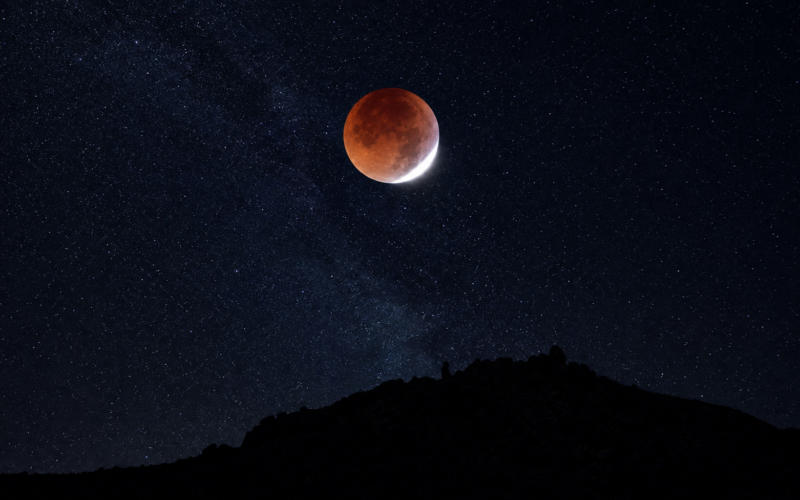
The Moon slid almost entirely into Earth’s shadow overnight, and if you were outside at the right moment you saw something close to a total lunar eclipse without it technically being one. At maximum, about 96 percent of the lunar disk sat inside the dark core of Earth’s shadow, turning most of the Moon a deep coppery red while a thin bright sliver held on at the edge. Astronomers had been circling this date for years, and it delivered.
What Actually Happened Overnight
This was a deep partial lunar eclipse, not a total one. The distinction is small in appearance and large in definition. The umbral magnitude reached 0.932, meaning roughly 96.2 percent of the Moon’s visible disk was inside Earth’s umbra at greatest eclipse. The remaining few percent never crossed the line, so the event stays in the partial category.
Visually, that missing sliver is what made it striking. A totally eclipsed Moon glows evenly. This one had a brilliant white rim on one edge against a body the color of old brick, a contrast that photographs far better than totality does.
The Timeline, Minute by Minute
The penumbral phase began at 01:23 UTC, when the Moon entered the faint outer shadow and started to dim in a way most people would not notice. The partial phase began at 02:33 UTC, which is when the bite out of the Moon became obvious. Greatest eclipse arrived at 04:12 UTC on August 28. The partial phase ended at 05:52 UTC and the penumbral phase closed at 07:02 UTC.
End to end the event ran 5 hours and 38 minutes, with the dramatic partial phase lasting 3 hours and 18 minutes. That is a long window by eclipse standards, which is part of why so many people caught at least some of it.
When It Peaked Where You Live
Greatest eclipse landed at 12:12 a.m. Eastern on August 28, 11:12 p.m. Central, 10:12 p.m. Mountain, and 9:12 p.m. Pacific on August 27. The full visible window on the East Coast ran from about 9:23 p.m. to 3:01 a.m.
West Coast viewers arguably got the best deal. Peak came at a reasonable hour, well before midnight, with the Moon high enough in the sky to clear most obstructions. East Coast viewers had to stay up past midnight for the main event.
Who Could See It
NASA listed visibility across the Americas, with the exception of Alaska and northwestern Canada, along with western Europe and western Africa. North and South America saw every phase from start to finish. Viewers in Europe and Africa caught it with the Moon low and setting, which is beautiful but harder to observe.
No equipment was required. Lunar eclipses are entirely safe to watch with the naked eye, unlike solar eclipses, and binoculars mainly help by making the color easier to read.
Why the Moon Turns Red
The color comes from Earth’s atmosphere. Sunlight passing around the edges of the planet gets scattered, with blue wavelengths thrown sideways and red wavelengths bent inward toward the Moon. What lands on the lunar surface is the combined light of every sunrise and sunset happening on Earth at that moment.
The depth of the red varies with how much dust, ash, and cloud is in the atmosphere. A year with major volcanic activity produces a darker, browner eclipse. A clear year produces a brighter orange one.
The Best One Until 2028
Space.com described this as the best lunar eclipse visible anywhere on Earth until New Year’s Eve 2028, when a total lunar eclipse is due. That is a meaningful gap. There will be lunar eclipses between now and then, but nothing that combines this much shadow coverage with this favorable a viewing window for the Americas.
If you missed it, that is the honest framing. This was not one of a dozen chances over the next couple of years.
Where It Sits in the Saros Cycle
Eclipses repeat in families called saros series, each running for centuries and slowly shifting deeper into Earth’s shadow. This one belongs to Saros 138, and it is the last partial eclipse that series will produce. From 2044 onward, Saros 138 eclipses will be total.
That is the kind of detail that separates a nice sky event from a genuinely notable one. Overnight viewers watched the final partial chapter of a cycle before it graduates.
A Big Sixteen Days for the Sky
This eclipse came just 16 days after the total solar eclipse of August 12, 2026, an unusually tight pairing that gave 2026 one of the strongest eclipse seasons in recent memory. Solar and lunar eclipses come in pairs by nature, but rarely with both halves this good.
For anyone planning to chase dark skies over the holiday weekend, the drive is a factor worth pricing out, and this year’s Labor Day gas prices shape that math more than usual. The Moon will be full and bright for the next few nights, so deep sky viewing will be poor, but the Moon itself stays worth a look.
Frequently Asked Questions
Was the August 2026 eclipse total?
No. It was a deep partial lunar eclipse, with about 96.2 percent of the Moon inside Earth’s umbra at greatest eclipse.
What time did it peak?
Greatest eclipse was 04:12 UTC on August 28, which is 12:12 a.m. Eastern, 11:12 p.m. Central, 10:12 p.m. Mountain, and 9:12 p.m. Pacific.
Where was it visible?
Across the Americas apart from Alaska and northwestern Canada, plus western Europe and western Africa.
Why does the Moon look red during an eclipse?
Earth’s atmosphere scatters blue light and bends red light onto the lunar surface. You are seeing every sunrise and sunset on Earth at once.
Do you need eye protection?
No. Lunar eclipses are safe to view with the naked eye. Only solar eclipses require filters.
When is the next major lunar eclipse?
A total lunar eclipse is due on New Year’s Eve 2028, and it is expected to be the next one of comparable quality.