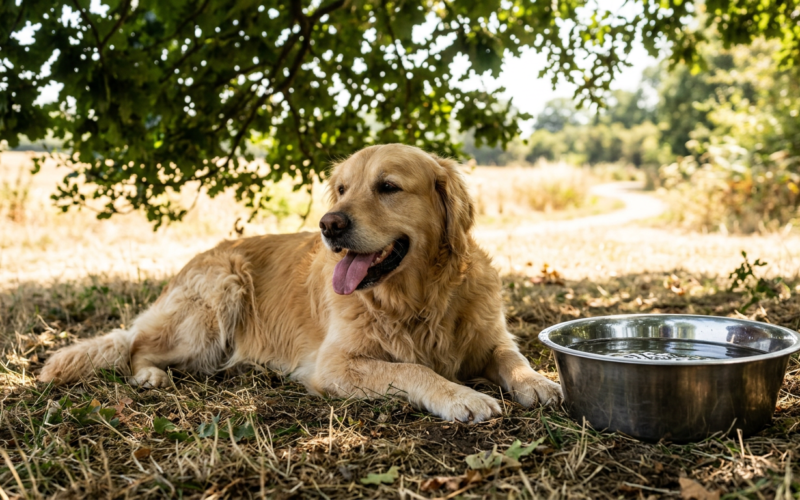
Roughly one in seven dogs who receive veterinary treatment for heatstroke does not survive it. That statistic is worth reading twice, because it reframes the whole conversation. Heatstroke is not a bad afternoon that a dog sleeps off. It is an emergency with a mortality rate, and by the time most owners recognize it, the damage has already started. Animal welfare groups counted 151 heat-related animal deaths and 365 heat rescues in 2025, and this summer has been tracking on a similar pace.
Dogs cannot sweat and that is the whole problem
People run on evaporative cooling across the entire surface of their skin. Dogs and cats do not. They rely almost entirely on panting, which moves heat out through the mouth and airway, plus a small amount through the pads of their feet. That system works well in dry moving air and fails badly in humidity. A humid eighty-five degree day is more dangerous to a dog than a dry ninety-five, and almost nobody adjusts for that.
The early signs are not dramatic
The picture people expect is a collapsed dog. The actual early stage is much quieter: panting that will not slow down when the dog stops moving, heavy drooling with thicker saliva than usual, restlessness or an inability to settle, and gums that have gone either bright red or unusually pale. Vomiting, wobbling, or any loss of coordination means you are past the early stage. That is a same-hour trip to a vet, not a wait-and-see.
The parked car is not the main risk anymore
Everyone knows about cars, and that message worked, which is why most heatstroke cases now come from something else entirely: an ordinary walk, a long game of fetch, or a dog left in a yard with shade that stopped being shade at two in the afternoon. Exercise-induced heatstroke on a normal summer day is the case veterinarians see most often. The dog was not trapped. The dog was just having fun and could not tell you it needed to stop.
Doghouses make it worse, not better
This one surprises people. A doghouse in summer functions as an oven. It is a small enclosed box with minimal airflow and a dark roof absorbing direct sun, and the interior can run hotter than the yard. What a dog actually needs outdoors is moving air and real shade, which means a tree, a tarp, or a covered porch, not a structure with three walls and a roof. Plus water in a bowl big enough that it does not go warm and empty in an hour.
Check the pavement with your hand
Asphalt holds heat long after the air has cooled, and a surface that feels tolerable through a shoe can burn a paw pad. The test takes five seconds: press the back of your hand flat to the pavement and hold it there. If you cannot keep it there comfortably, your dog should not be walking on it. In most of the country in late July, that rules out roughly the entire span from mid-morning to early evening.
Cool the dog down the right way
If you suspect heatstroke, get the dog into shade or air conditioning, offer small amounts of cool water, and wet the body with cool, not ice-cold, water, focusing on the belly, armpits and groin where blood vessels sit close to the surface. Ice water and ice packs can constrict surface vessels and actually slow heat loss. Then call a vet regardless of whether the dog seems to perk up, because internal damage from heatstroke can present hours later.
Some dogs are at much higher risk than others
Risk is not evenly distributed and it is worth knowing where your dog sits. Flat-faced breeds such as bulldogs, pugs and boxers have compromised airways, which means panting works far less efficiently for them and heatstroke can arrive shockingly fast. Older dogs, overweight dogs, black-coated dogs, very young puppies and any dog with existing heart or respiratory issues all carry elevated risk. A fit two-year-old retriever and a seven-year-old bulldog on the same walk are not having remotely the same experience.
Heat changes behavior too
A less obvious finding: research has linked rising temperatures to increases in dog bites, and to more erratic behavior in wildlife. There is also work indicating snakebite risk rises measurably with temperature, on the order of six percent for every degree Celsius. Practical translation for a summer walk: a hot dog is a shorter-tempered dog, other people’s hot dogs are shorter-tempered too, and the tall grass is more populated than usual. Keep the leash short. If you want the low-risk version of a summer outing, early morning trail time is having a moment for good reason.
Frequently Asked Questions
What are the first signs of heatstroke in a dog?
Panting that does not slow after the dog stops moving, thick drooling, restlessness, and gums that look bright red or unusually pale. Vomiting or unsteady walking means it is already advanced.
How deadly is dog heatstroke?
About one in seven dogs treated for it does not survive, which is why it should be treated as an emergency rather than something to monitor at home.
What temperature is too hot to walk a dog?
There is no single number, because humidity matters as much as air temperature. Use the pavement test: if you cannot hold the back of your hand on it comfortably, it is too hot.
Should I use ice water to cool an overheated dog?
No. Cool water is better. Ice-cold water can constrict surface blood vessels and slow the heat loss you are trying to create.
Is a doghouse good shade?
No. Enclosed doghouses trap heat and can be hotter than the surrounding yard. Dogs need open shade with airflow and plenty of fresh water.
Do dogs still need sun exposure?
They enjoy it and moderate sunbathing is fine, as long as they always have access to cool shade and water and can move themselves out of the heat.