For twenty years the case against the American lawn was made by people who cared about pollinators, and it lost, politely, every summer. What finally moved the needle was arithmetic. Lawn replacement is spreading through neighborhoods that never attended a native plant lecture, because keeping turf green through a hot dry summer now costs real money and takes an afternoon a week that nobody has. The ecological argument was correct. The water bill is what closed.
What Cities Are Actually Seeing
Longmont, Colorado reported this week that municipal water use continues to trend downward as more homeowners replace non functional turf with water wise landscapes. That phrase, non functional turf, is doing quiet work across the West. It describes the grass nobody walks on, the strip between sidewalk and street, the side yard nobody enters. Removing it costs a household nothing in utility and saves a measurable amount of water.
The Rebate Programs Changed the Math
Many western utilities now pay per square foot for turf removal, and those programs have moved the decision from a moral one to a financial one. When the utility covers a meaningful share of the conversion and the ongoing water bill drops afterward, the payback period stops being theoretical. Check what your own utility offers before you plan anything, because the rebate frequently requires preapproval and photos of the existing lawn.
Native Does Not Mean Neglected
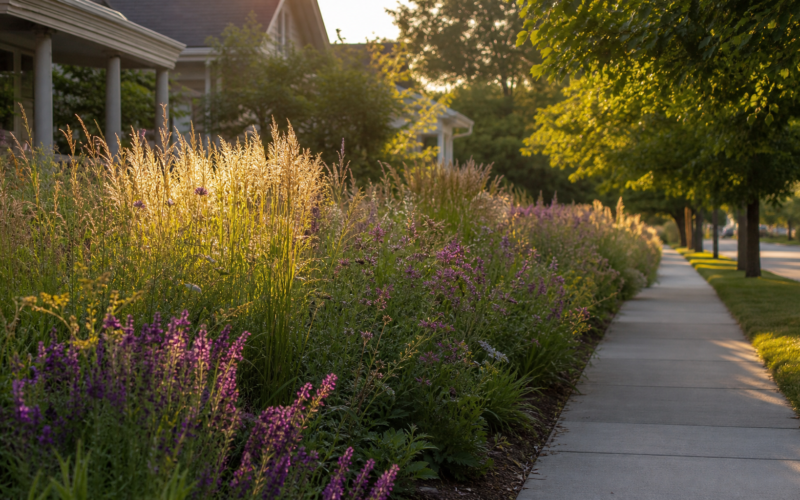
The most common objection is that native plantings look unkempt, and honestly, a badly done one does. Native plants are adapted to local rainfall and soil, which means less irrigation, fewer inputs and less mowing, but they still need structure. Defined edges, repeated groupings of the same species rather than one of everything, and a mown border strip do most of the work of making a naturalistic planting read as intentional rather than abandoned.
The Plant by Number Shortcut
The genuinely useful innovation of the last two years is the prepackaged regional kit. These supply a plan and the corresponding plants for a defined area, matched to your region, which solves the actual barrier for most people. The barrier was never willingness. It was standing in a nursery with no idea which forty plants go together and in what proportion. A plan removes the paralysis.
Ground Cover Is the Easier Entry Point
If tearing out the whole yard feels like a lot, low growing ground covers are the gentler version of the same move. They tolerate light foot traffic, suppress weeds once established, need a fraction of the water, and never need mowing. Clover, creeping thyme and regional sedges all work depending on climate and sun. This is the version of the project that does not require explaining yourself to the neighborhood.
The Part That Genuinely Annoys People
It is worth being honest about the friction. Establishment takes two seasons and looks rough for most of the first one. Some homeowner associations still have turf requirements, though a growing number of states have limited their ability to enforce them. Weed ordinances written for vacant lots sometimes get applied to intentional meadows. And a neighbor who liked looking at your grass may take a while to come around, which several homeowners have documented at length.
Soil preparation is the step people skip and then regret. Turf leaves behind compacted ground and a thatch layer that new plantings struggle to penetrate, so pulling up the grass without addressing what lies underneath produces a bed that looks fine in April and fails in July. Sheet mulching over the existing lawn, which smothers the grass and improves the soil at the same time, takes a season longer but costs almost nothing and gives far better establishment than stripping turf and planting into what remains.
What It Actually Saves
Outdoor irrigation is the largest single household water use in much of the arid West, and turf is the bulk of it. Cutting the irrigated area substantially cuts the summer bill in the months when it peaks. You also stop buying fuel, fertilizer and time. A yard that needs attention four times a year instead of thirty is a different relationship with your weekend, and that is the benefit people report most once the second season arrives.
Starting Without Overcommitting
Take one section. The hell strip along the curb is the traditional starting point because it is small, visible, hard to grow grass in anyway, and usually qualifies for a rebate. Do that one area properly, see how it establishes through a full year, and expand from there. It is a rare home project where the cheap version is also the sensible version, which is worth appreciating in a year when most household costs are moving the wrong way and financing anything is expensive.
Frequently Asked Questions
How much water does replacing a lawn actually save?
Outdoor irrigation is the largest household water use across much of the arid West, and turf accounts for most of it. Cutting irrigated area produces the biggest savings during peak summer months.
Will my homeowner association allow it?
Increasingly yes. A number of states have restricted the ability of associations to mandate turf, but rules vary widely and checking your specific covenants before starting is essential.
Do native plants look messy?
They can if planted without structure. Defined edges, repeated groupings and a mown border strip make a naturalistic planting read as deliberate rather than neglected.
How long until it looks established?
Plan on two growing seasons. The first year is mostly root development and will look sparse. The second year is when most plantings fill in and start performing.
What is the cheapest way to start?
The strip between sidewalk and street. It is small, often qualifies for a rebate, and is the hardest place to keep grass alive anyway, so the conversion is an easy win.
Can I do this in a rainy climate?
Yes, though the water savings argument is weaker. In wetter regions the case rests more on reduced mowing, pollinator habitat and eliminating fertilizer and fuel.